Camellia sinensis
Common
Names: tea, tea plant, tea tree
Botanical
Family: Theaceae (tea Family)
DescriptionThe
source of the world's most popular caffeine drink, the tea plant is an
evergreen shrub or small tree with glossy dark green elliptic leaves.
Var.
sinensis, the most widely grown variety, gets 5-10 ft (1.5-3.1 m)
tall, and has leaves 1-3 in (2.5-7.6 cm) long and 1-2 in (2.5-5.1 cm)
wide. Var. assamica (Assam or wild tea) can get up to 50 ft (15.2 m)
tall and has larger leaves, 6-10 in (15.2-25.4 cm) long and 3-5 in
(7.6-12.7 cm) wide. Tea plants bloom in the autumn with fragrant,
nodding cup shaped flowers about 1 in (2.5 cm) wide. The seven or eight
petals are white. In commercial tea plantations the plants are kept
pruned to about 4 ft (1.2 m) tall and flowers are rarely produced.
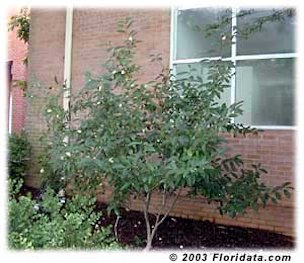 |
| This tea plant enjoys a sheltered microclimate at the Atlanta Botanical Garden in Atlanta, Georgia. |
LocationThe typical variety (var. sinensis)
is probably native to western China. It has been cultivated for
centuries, mostly in plantations in China and at high elevations in
tropical southern Asia. More recently it is being cultivated in other
areas of the world with suitable mild and humid climates. Assam tea
(var. assamica) occurs naturally in tropical and subtropical southeastern Asia and is cultivated extensively in India and Sri Lanka. CultureLight: Seedlings and young tea plants should be shaded; mature plants produce best in full sun.Moisture: Tea plants need plenty of moisture. They do best in rather humid climates. Hardiness:
USDA Zones 9 - 11. Tea plants do best in a cool, but frost-free
climate. They can, however, withstand light freezes when dormant.Propagation:
Tea plants are propagated by rooting semiripe cuttings, and by budding,
grafting, and air layering. Teas are sometimes grown from seed as well.
UsageThe
tender young leaves from tea plants are plucked and variously
"fermented" (actually oxidized - no yeast or microbes are involved),
then dried to make green, black or oolong teas. Green tea is made from
fresh leaves that are steamed and wilted, then dried immediately. Black
tea is made from leaves that are wilted and crushed in rollers, then
allowed to oxidize for several hours before they are dried. Oolong tea
comes from leaves that are only partially oxidized before drying. Black
teas are graded by the size of the particles. This is important since
larger pieces take longer to brew. The Pekoe teas are supposedly the
highest quality black teas, made from the youngest, "first flush" of
leaves. Orange Pekoe is the best, made into long, thin, twisted leaves;
regular Pekoe tea leaves are more open. Souchong teas are black teas
with larger open, coarse leaves. In India they mostly make black teas,
including the full-bodied Assam tea and the delicate Darjeeling,
sometimes called the "champagne of teas." Green teas are graded based
on the age of the leaves and the method of preparation. Gunpowder teas
consist of little tightly rolled balls of young leaves; they produce a
pale-colored green tea known for its sharp, distinctive flavor.
Imperial is like Gunpowder but with larger, looser pieces of leaf. Earl
Grey is a black tea flavored with oil of bergamot (a type of sour
orange,
Citrus aurantium). Teas are sometimes flavored with jasmine flowers (see Arabian jasmine), orange blossoms (
Citrus sinensis),
rose petals, apples or mangos. In addition to its nearly universal
popularity as a beverage, tea also is used as a flavoring in various
foods, including ice cream, and fish and meat dishes.
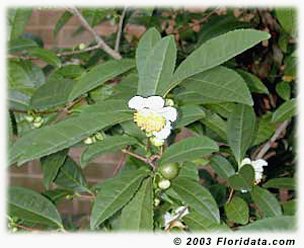 |
| These are tea leaves and flowers of var. sinensis |
FeaturesTea
(the beverage - not the plant) was introduced into Europe in the middle
16th century. By the 1700's it began to replace beer as the beverage of
choice at breakfast.
Research has shown that tea contains
components that inhibit tooth decay. Decoctions of green tea aid
digestion and help to ward off cancers. It has been shown that people
who drink at least one cup of tea a day have a lower risk of heart
disease, stroke and cancer. Brewed tea contains large quantities of
antioxidants - more in fact than any other fruit or vegetable.
The
antioxidants in tea (various polyphenols) are more effective at
neutralizing damaging free radicals than those in other foods. (Free
radicals are highly unstable molecules produced in the body by normal
metabolism and by exposure to radiation, chemicals and heavy metals;
free radicals damage cells, proteins and fats in the body,
theoretically causing a wide range of diseases including even the aging
process.)
Decaffeinated tea has just as much antioxidant
activity as normal tea, and adding milk, lemon juice or sugar does not
reduce the antioxidant effects either. Powdered instant teas and
bottled iced teas do contain fewer antioxidants than brewed tea, but
still more than most individual fruits and vegetables. Many studies
have demonstrated that green tea, either consumed internally or applied
directly to the body, can protect lab animals against breast, colon,
skin, liver, stomach, pancreas and esophagus cancers. It appears that
tea can kill or slow the growth of cancer cells while leaving normal
cells unscathed. Green teas have been studied the most, but black and
oolong teas may be just as effective. To get the most benefit, steep
tea bags for a full five minutes in boiled water.
Camellias (
Camellia japonica) and sasanquas (
Camellia sasanqua) are closely related ornamental shrubs.