| Pindo Palm - Butia odorata | |||||
|---|---|---|---|---|---|
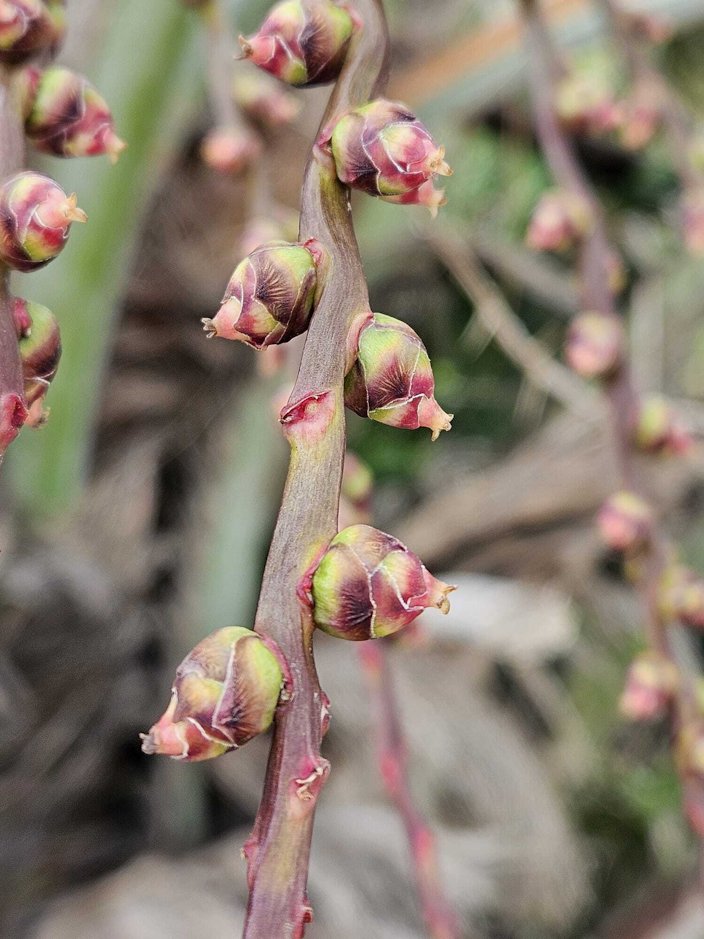
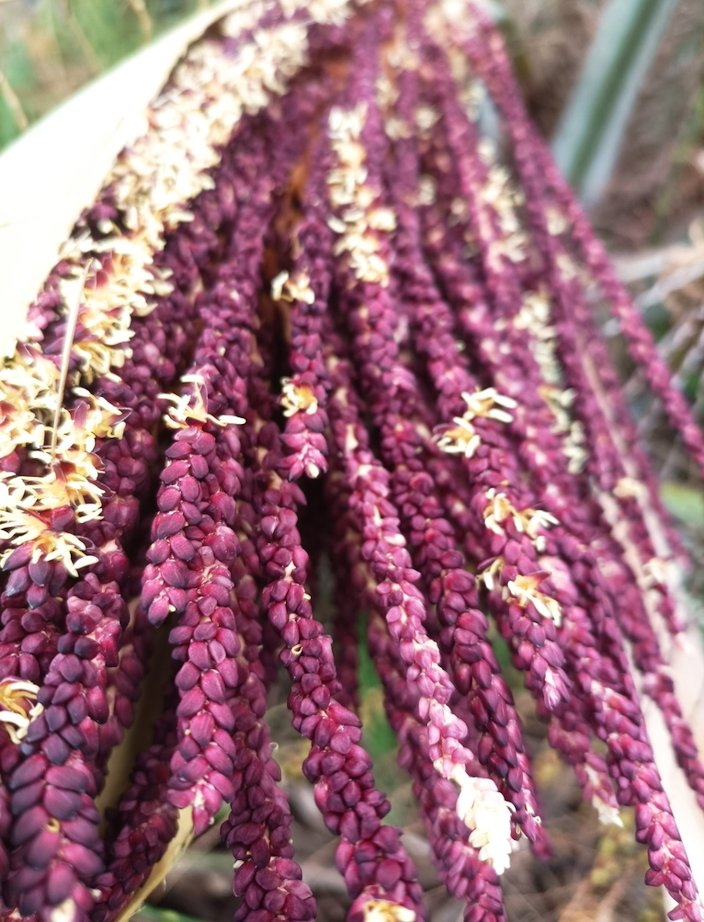
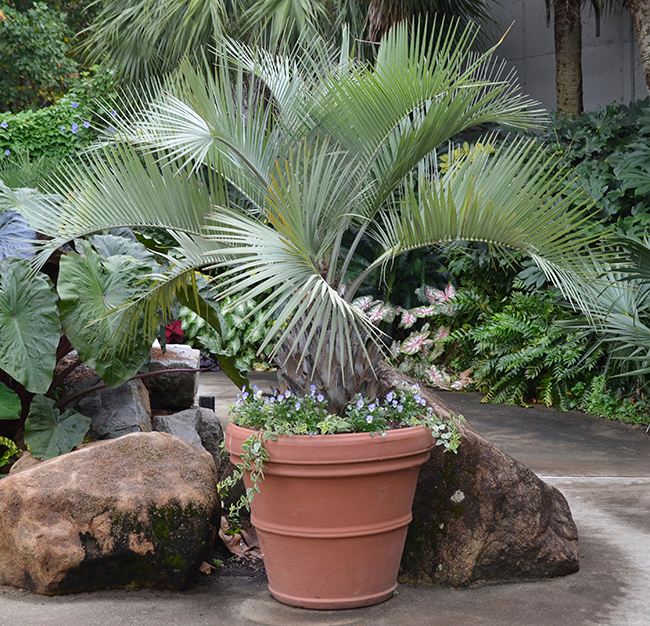 Fig. 1 Butia odorara in container 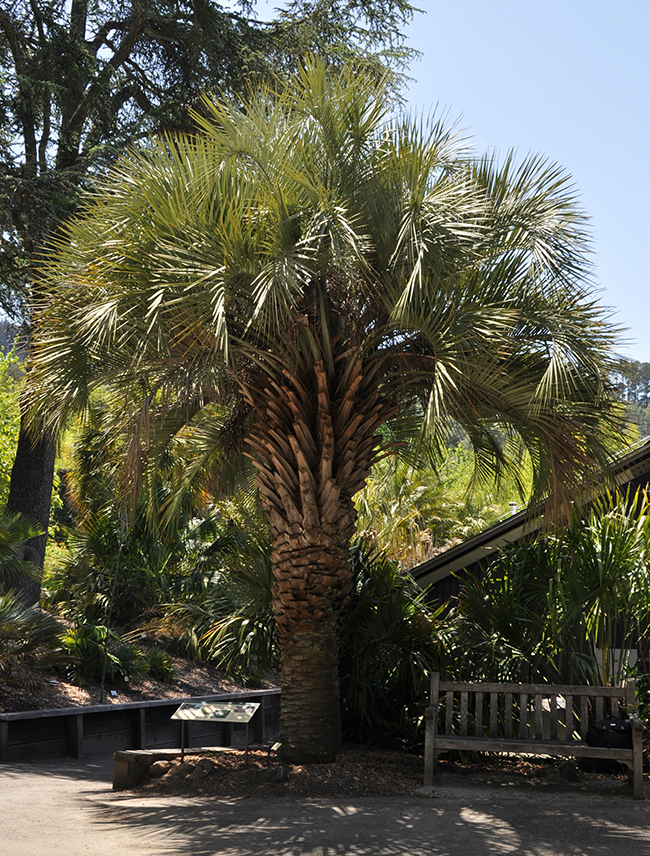 Fig. 2 B. odorara young tree 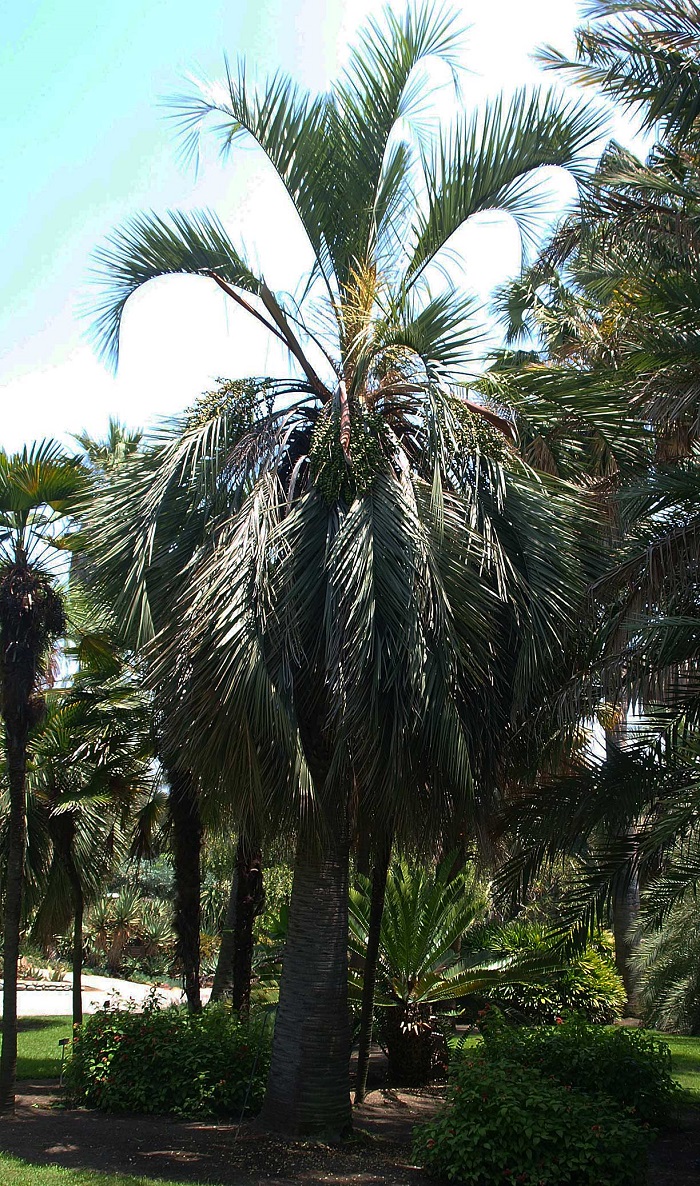 Fig. 3 Fig. 3Butia odorata older individual in the landscape with smoother stem and leaf scars rings 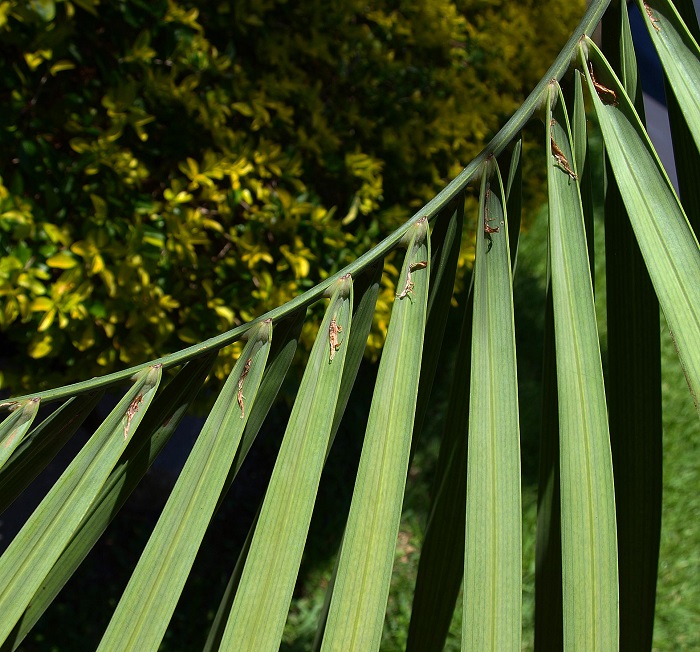 Fig. 4 B. odorara leaflet with ramenta visible on the underside (closer view) 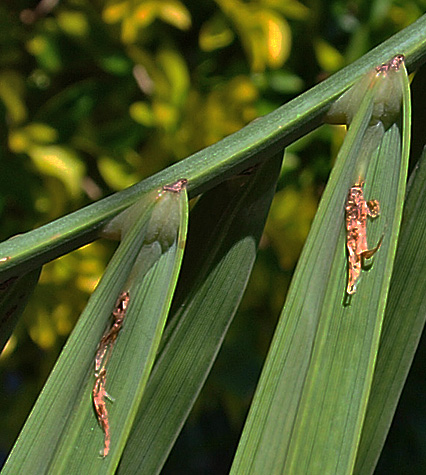 Fig. 5 Ramenta visible on the underside 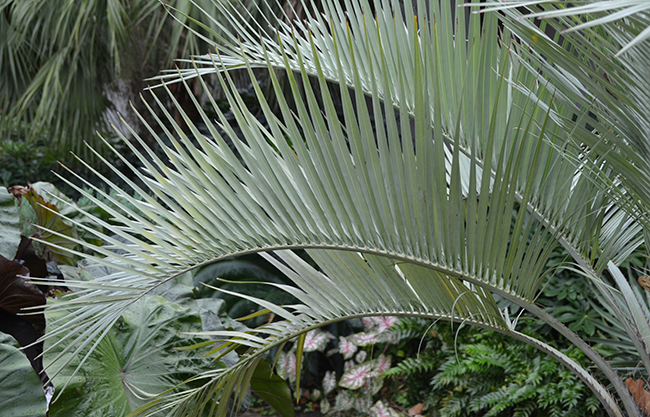 Fig. 6 Fig. 6B. odorara leaves 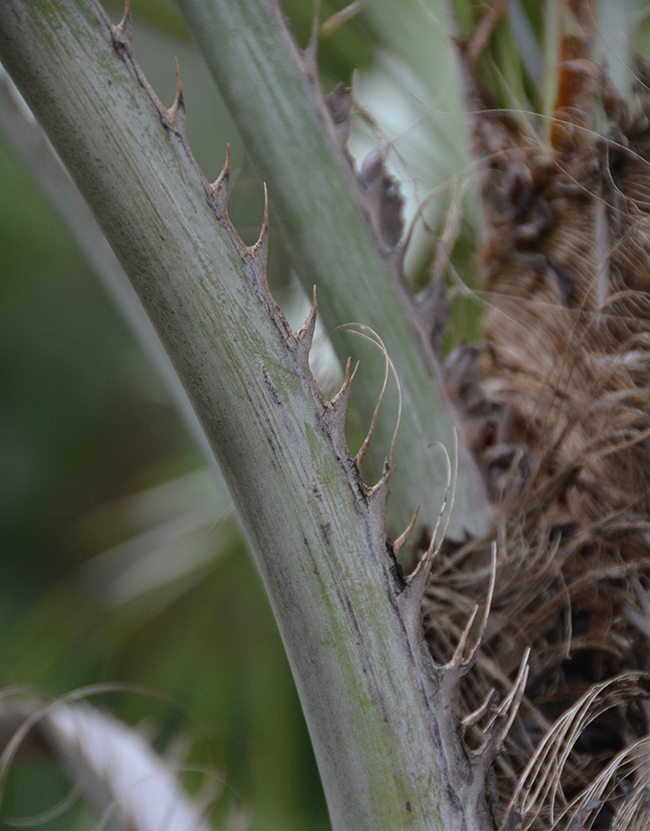 Fig. 7 B. odorara stem 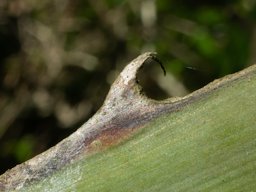 Fig. 8 Close-up of the stout, sharp teeth along the margin 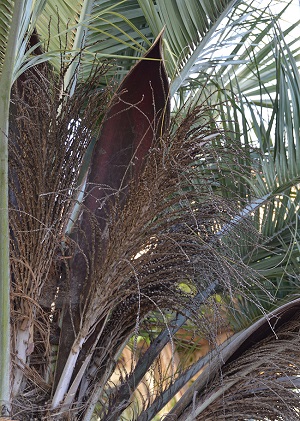 Fig. 9 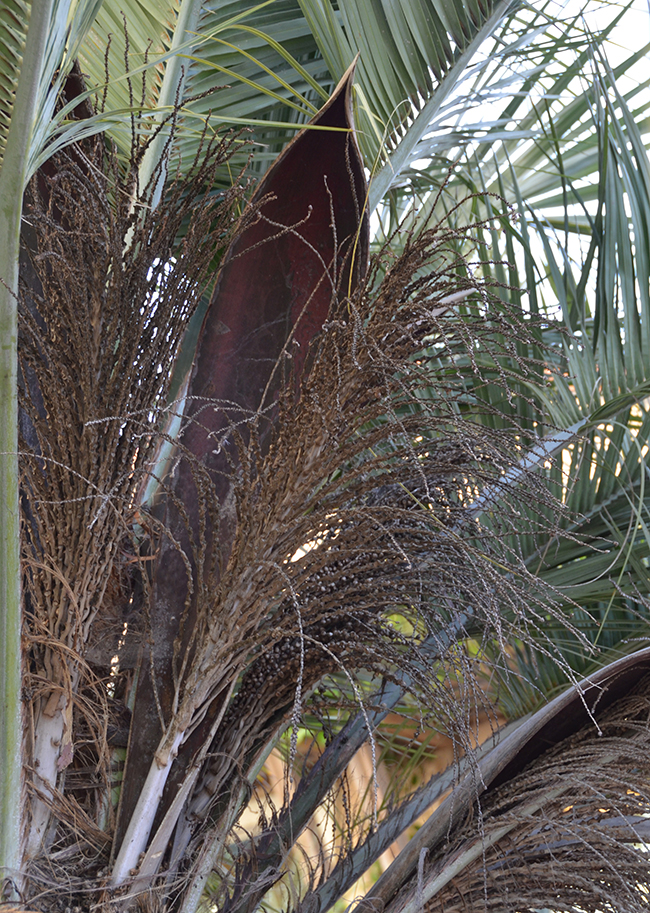 B. odorara fruit stalks 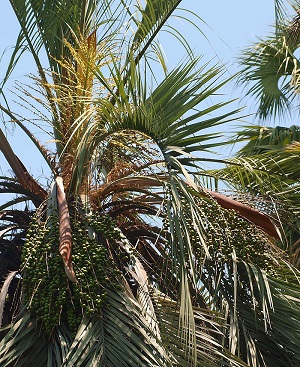 Fig. 10 B. odorara inflorescence 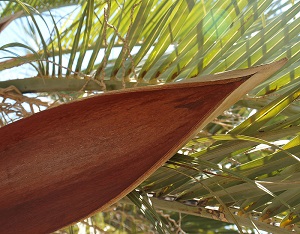 Fig. 13 B. odorara beaked, woody spathe previously covering inflorescence 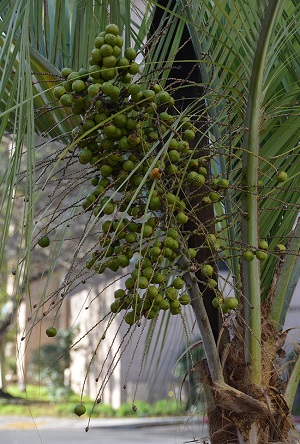 Fig. 14 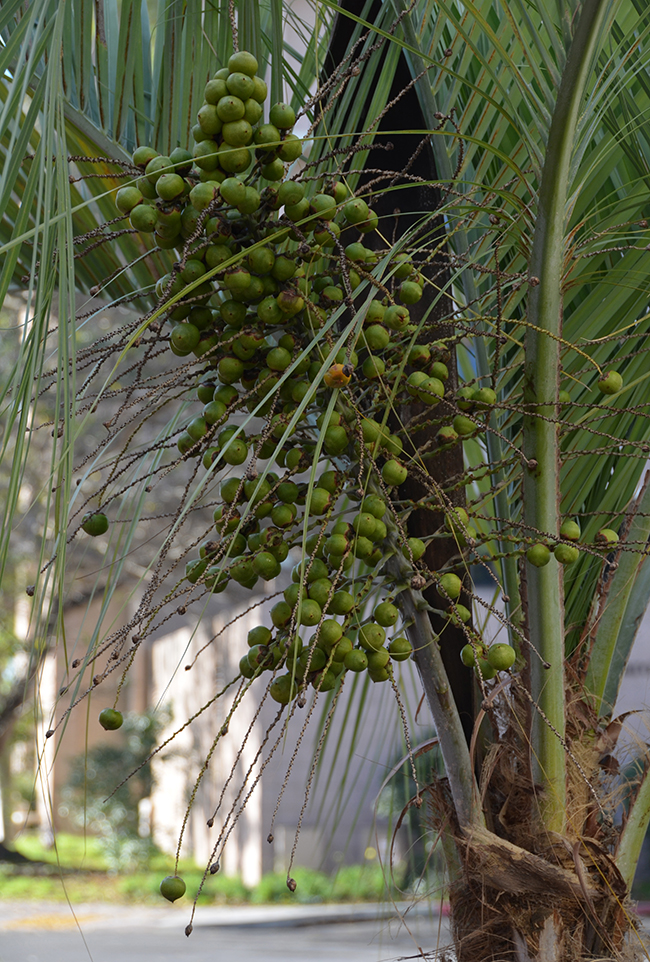 B. odorara immature fruit 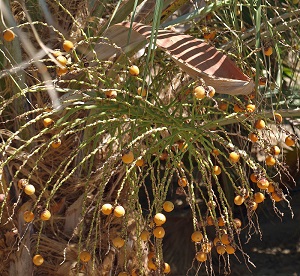 Fig. 15 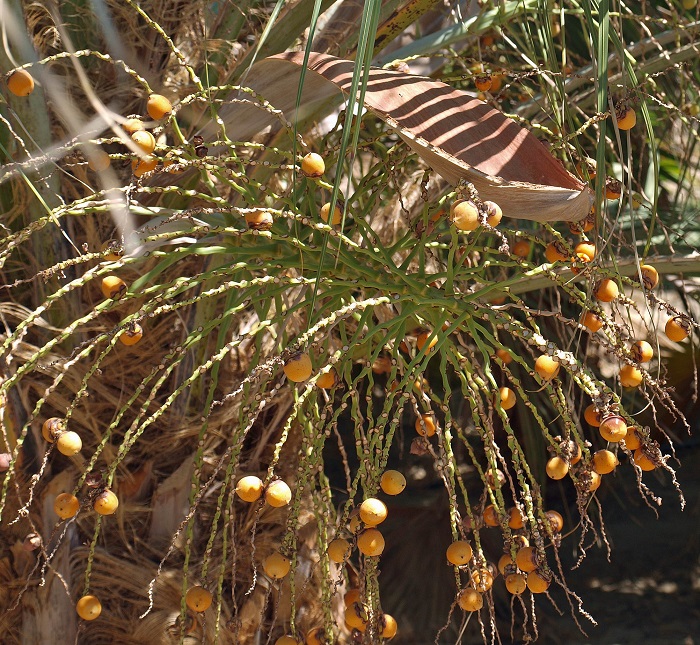 B. odorara Ripe Fruit 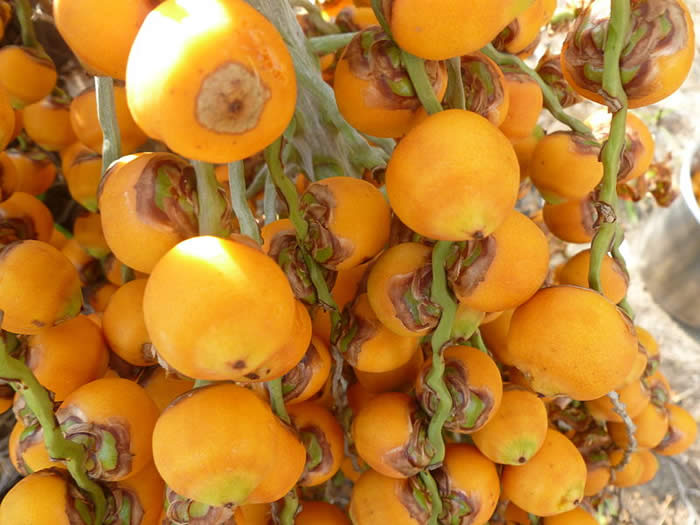 Fig. 16 Ripe fruit of B. odorara 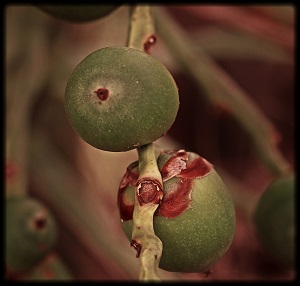 Fig. 17 Jelly palm fruit 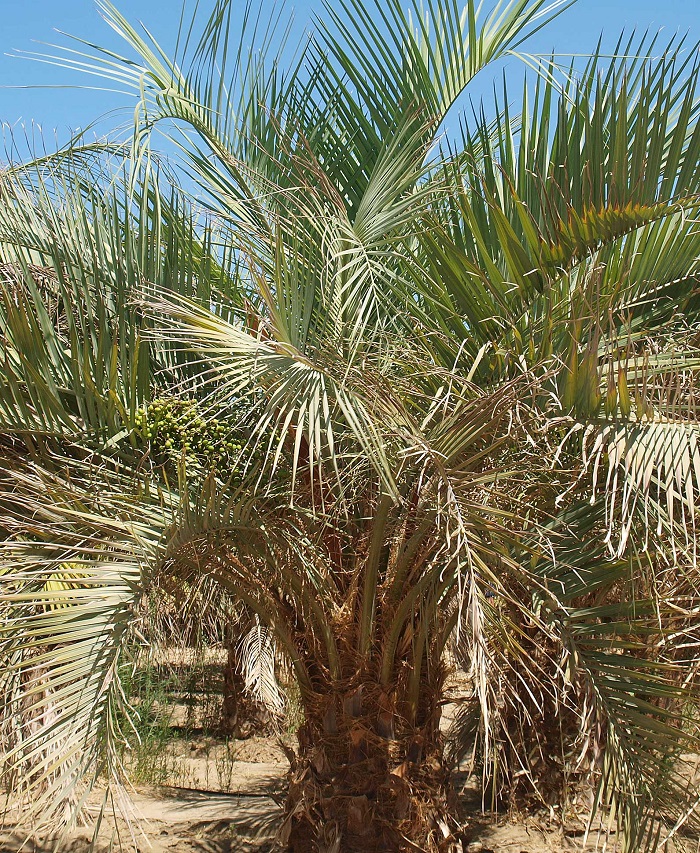 Fig. 18 South American Jelly Palm Butia odorata, Santo Antônio da Patrulha, RS, Brasil 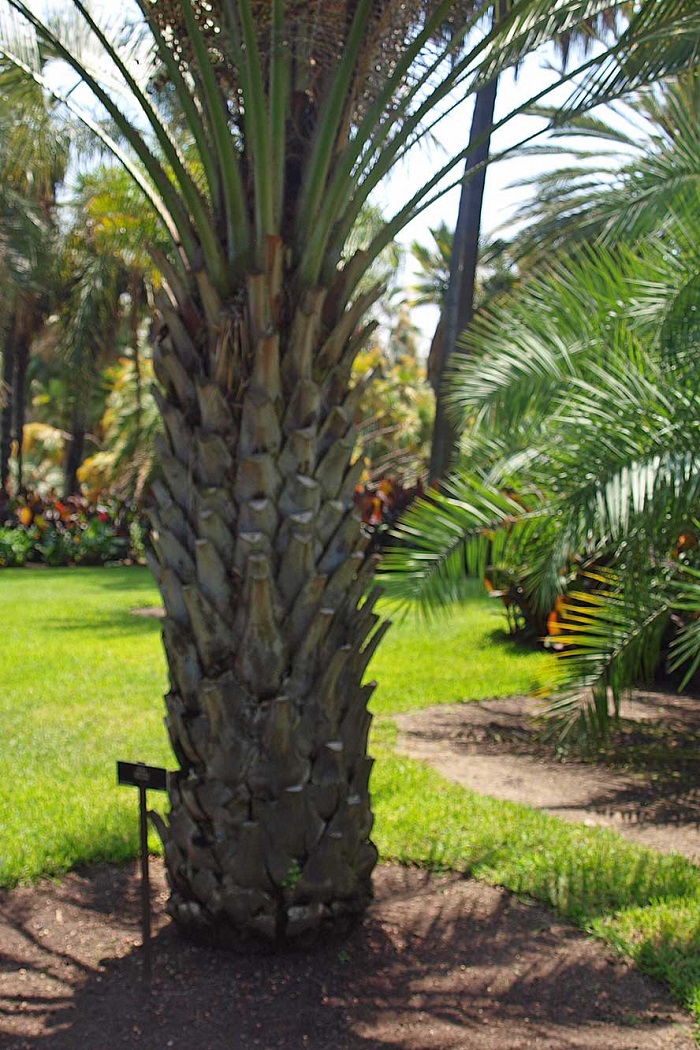 Fig. 19 B. odorara with persistent leaf bases 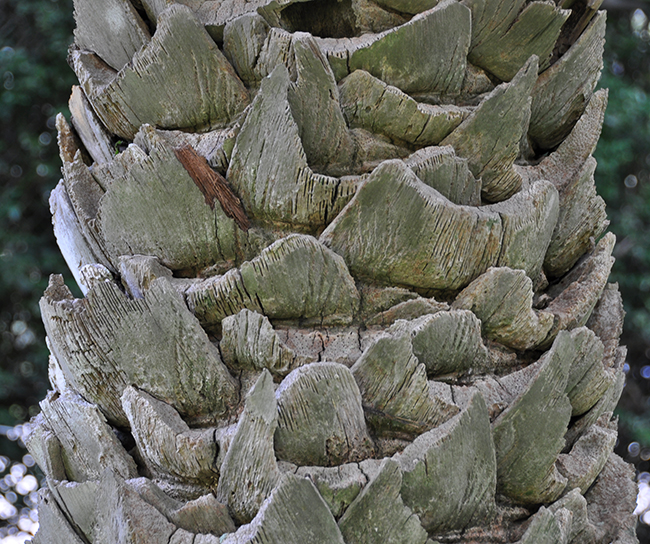 Fig. 20 Close up of the persistent leaf bases 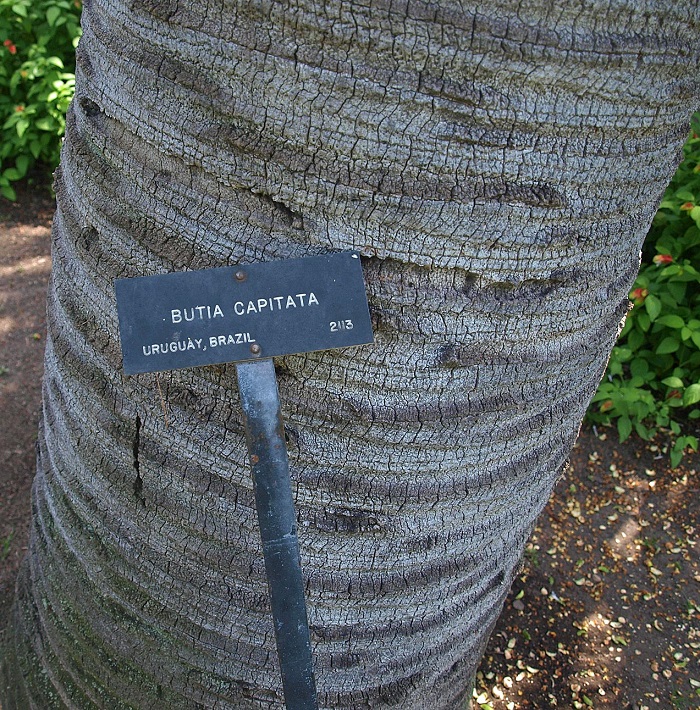 Fig. 21 B. odorara stem with leaf scars Back to Edible Palms |
Scientific
name Butia odorata (Barb.Rodr.) Noblick Pronunciation BEW-tee-uh oh-dor-RAH-tah 9 Common names Pindo Palm, Wine Palm, Jelly Palm Synonyms B. capitata var. elegantissima (Chabaud) Becc.; B. capitata var. erythrospatha (Chabaud) Becc.; B. capitata var. lilaceiflora (Chabaud) Becc.; B. capitata var. nehrlingiana (Abbott ex Nehrl.) L.H.Bailey; B. capitata var. odorata (Barb.Rodr.) Becc.; B. capitata var. pulposa (Barb.Rodr.) Becc.; B. capitata var. rubra Mattos; B. capitata var. strictior L.H.Bailey; B. capitata var. subglobosa Becc.; B. capitata var. virescens Becc.; B. capitata subsp. yatay (Mart.) Herter 4 Relatives Yatay Palm (B. yatay), Queen Palm (Zyagrus romanzoffiana) Family Arecaceae (palm family) Origin Native to central-southern Brazil and adjacent areas of Uruguay and Argentina USDA hardiness zones 8-10b; performance is best above 10b; it is reputedly hardy into the Carolinas 5 Uses Plant as an atractive specimen or in groups; suitable for planting under power lines; produces tasty fruit Height Slow-growing to about 15-20 ft (4.5-6 m) Spread 10-15 ft (3-4.5 m) Crown Canopy of 40-50 leaves; symmetrical, open Growth rate Slow Longevity Up to 80 years Trunk/bark/branches Single-trunked; heavy, stocky; branches don’t droop; not showy; thorns Pruning requirement Prune diseased, damaged or drying fronds, remove flower stalks to avoid messy cleanups 1 Leaves Arching, blue-green, 4-6 ft (1.2-1.8 m), pinnate leaves are crowded with many upward-pointing leaflets that form a pronounced V-shape; petiole is armed with stout, sharp teeth along the margin (Fig.7); leaflets are about 2-1/2 ft (50 cm) long and 1 in. (2.5 cm) wide 3 Flowers Numerous, very small creamy yellow to reddish flowers are borne on once-branched, 3-4 ft (1 m); long inflorescences bearing separate male and female flowers 3 Fruit The 1 in. (2.5cm), yellow to orange-colored fruits are round to oval-shaped, and hang in large sprays from the tree. Each fruit contains a single seed. The sweet-tart flavor is reminiscent of both apricots and a pineapple-banana mixture. 3 Season Summer Light requirement Full sun to moderate shade (the fronds grow longer in shady situations, giving the palm a more graceful aspect than those grown in full sun 6 Soil tolerances Likes sandy soil, but is adaptable to clay and loam both slightly alkaline and acidic pH preference Acidic to alkaline Drought tolerance Drought tolerant Soil salt tolerance It is moderately salt tolerant, but does a lot better inland then it does on the coast Wind salt tolerance Intolerant of salt spray Cold tolerance Can withstand low temperatures of at least 15 °F (-9 °C) The jelly palm is the hardiest feather-leafed palm currently in wide cultivation Wind Resistance The trees are very wind-tolerant Plant spacing Plant 10-13 ft (3-4 m) apart as a street tree and they can be planted beneath power lines due to slow growth and small size Roots Roots are not a problem Invasive potential * Not a problem species (un-documented) Pest resistance Palm leaf skeletonizer, scale, and micronutrient deficiencies (especially Mn and Fe) are occasional problems Known hazard Spiny; produces a large quantity of fruit, which can be a nuisance, as ripening fruit attracts wasps and other insects 6 Reading Material Jelly Palm, California Rare Fruit Growers Butia capitata, Floridata Pindo Palm: Jelly, Wine and Good Eats, Eat The Weeds Butia odorata: Pindo Palm, University of Florida pdf Origin Native to the grasslands, and dry woodlands and savannahs of central-southern Brazil and contiguous Argentina and Uruguay. 5 The pindo or jelly palm was formerly known by the scientific name Butia capitata. However, recent research has shown that the correct name for this palm should be B. odorata. 7 Description Solitary, erect, to 6 m tall and 50 cm in diameter, covered with old, woody leaf bases or ridged with leaf scars. Leaves: pinnate, reduplicate, with a twisting, arched rachis. The petiole is armed with spines along the margins (Fig. 7); the linear, blue-green or gray-green leaflets, with large brownish ramenta on the abaxial surface, are regularly arranged and form a V-shape. 2 Jelly palms vary considerably in nature, the forms differing in ultimate height, trunk thickness, leaf color and amount of arching, and fruit color and taste. Their neat, compact growth makes them very attractive landscape features. They are widely used as specimen trees in California and northern Florida, where they also function well in median and avenue plantings. 3 Flowers A woody, beaked spathe covers the 3 ft (1 m) inflorescence (Fig. 14) which is branched once. Staminate and pistillate flowers are produced on the same inflorescence and may be reddish to yellow in color. 2
Fruit This palm produces a large quantity of fruit, which can be a nuisance, as ripening fruit attracts wasps and other insects. Remove flower stalks to avoid messy cleanups. The pindo fruits are rather tasty, but you probably don't need 50 pounds of them! 2 Varieties Pindo palms can hybridize with the related queen palm (Syagrus romanzoffiana). The offspring, known as mule palms (Butiagrus nabonnandii), are popular for their cold hardiness, larger size, and dark green foliage. 7 Harvesting Jelly palm fruits are picked as they ripen. If whole bunches are harvested, they tend to ripen all at once. 3 Pollination Pollination is by wind and insects. Propagation Fresh seeds germinate quickly within a month of being planted and the seedlings are attractive. Young palms are often found under palms that have been allowed to produce fruit. It is not unusual to see offspring growing in the old leaf boots of a mature tree. Palm Seed Germination, University of Florida pdf Planting Good drainage is also important. The root system of this species is very sensitive and good sized specimen is extremely difficult to successfully dig and transplant to another location. The fruit, maturing in summer, can be messy on side-walks or patios, so you may want to plant 3 metres (10 ft) away from the walk or patio. 1 Container Production of Palms, University of Florida pdf Culture Jelly palm prefers a warm, sunny location. Its leaves grow longer in partial shade situations, giving the palm a more graceful aspect than those grown in full sun, but they lose much of their silvery color. This variety is one of the hardiest of the feather-leaved palms. It has some drought tolerance due to its deep root system. It is moderately salt tolerant but intolerant of full shade, prolonged cold, and wet soil. 9 Pruning Prune diseased, damaged or drying fronds, but do not prune if the frond still has some green color. Palms recycle nutrients from dead or dying fronds and use them for healthier fronds. Palms only have a set number of new leaves that can sprout and grow per year and removing fronds will not increase that number. If you cut off more than what will grow annually, you could be left with a pretty bare and bald Palm. 1 Fertilizing To prevent or correct nutrient deficiencies (potassium and manganese) in pindo palms, 3 (4 in south Florida) applications per year of a controlled release 8N-2P2O5-12K2O-4-Mg plus micronutrients fertilizer are recommended. 7 Specimens raised in dry and/or infertile soils tend to be smaller in stature with smaller leaves. 8 Palm Nutrient Dediciencies Irrigation Drought tolerant, it thrives in fairly dry and hot climates, but enjoy also rainy climates and proved to tolerate a wide variety of conditions. In areas where summer rain is prevalent, it seems to put on rapid growth with this ample water, but it does not want to sit in continually wet, mucky soil. The roots and lower trunk can rot if soil is kept too moist. Pests The major pest problem is scale. Diseases Pindo palms are remarkably disease resistant. Major disease or physiological problems are ganoderma, stigmina leaf spot, graphiola false smut and phytophthora bud rot. 5,7 Food Uses The fruits can be eaten fresh and pureed, or used to make an excellent jelly as well as fermented to make wine; they can be stored for about a week under refrigeration; the seeds (inside the fleshy fruit) may be roasted, ground and used as a coffee substitute. 3 The best quality pindo fruits are very sweet with a flavor some find reminescent of a pineapple/banana mixture. 5 The heart of the Pindo Palm is edible. Other Uses Either as a single specimen or in groups, this is a strikingly beautiful species. Its very neat appearance and stature makes it perfect near highways and used to accent residential landscapes. Culture in containers is possible although growth rates are slower. A bright patio will provide an excellent environment for young specimens which can eventually be planted in a sunny location. 1 General Pindo palm is the hardiest feather-leafed palm currently in wide cultivation. It is used throughout the northern half of Florida as a specimen plant, funtionning well in median and even avenue plantings, despite its relatively small Stature. 5  Fig. 22 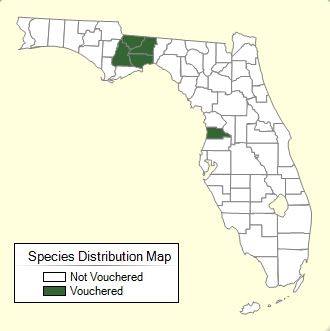 Fig. 22. B. capitata distribution map, wild populations Other Edible palm species: Cabbage Palm - Sabal palmetto California Fan Palm - Washingtonia filifera Canary Island Date Palm - Phoenix canariensis Coconut Palm - Cocos nucifera Date Palm - Phoenix dactylifera Peach Palm - Bactris gasipaes Salak Palm - Salacca zalacca Butia odorata Botanical Art Further Reading Jelly Palm, Identifying Commonly Cultivated Palms ext. link Validation of the Name Butia odorata, he Montgomery Botanical Center, Miami, Fl. pdf List of Growers and Vendors |
||||
|
Bibliography 1 "Butia capitata." LLIFLE Encyclopedias of living forms, The Encyclopedia of Palm & Cycads, 2005, www.llifle.com/Encyclopedia/PALMS_AND_CYCADS/. Accessed 17 Jan. 2014. 2 Anderson, P. J. "Butia capitata." Identifying Commonly Cultivated Palms, a Resource for Pests and Diseases of Cultivated Palms, Florida Department of Agriculture and Consumer Service, Division of Plant Industry and Identification Technology Program, CPHST, PPQ, APHIS, USDA; Fort Collins, CO. 2011, idtools.org/id/palms/palmid/. Accessed 16 Jan. 2014. 3 "Jelly Palm." California Rare Fruit Growers, crfg.org, 1998. Accessed 16 Jan. 2014. 4 "Butia capitata (Mart.) Becc." World Flora Online, www.worldfloraonline.org/taxon/wfo-0000915484. Accessed 14 Jyly 2026. 5 Merrow, Alan. Bedrock' Guide to Landscape Palms, Bedrock Information Systems, Hollywood, 2004. 6 Christman, Steve. "Butia Capitata." Floridata Plant Encyclopedia, floridata.com/plant/15. Accessed 25 Nov. 2015. 7 Broschat, Timothy K., et al. "Butia odorata: Pindo Palm." Environmental Horticulture Dept.,UF/IFAS Extension, st105/ENH264, Pub. date Nov. 1993, Rev. Apr. 2015, Reviewed Dec. 2017, Released 15 Feb. 2024, doi.org/10.32473/edis-st105-2015, AskIFAS, ask.ifas.ufl.edu/st105. Accessed 25 Apr. 2017, 3 July 2026. 8 "Butia odorata." Palmpedia, palmpedia.net/wiki/Butia_capitata_(True). Accessed 26 Nov. 2015. 9 "Butia odorata." Extension Gardener Plant Toolbox, North Carolina State Extensio plants.ces.ncsu.edu/plants/butia-odorata/. Accessed 10 July 2026. Photographs Fig. 1,2,7,9,13,18 M. Ritter, et al. "Butia capitata Tree Record." SelectTree UFEI, Urban Forest Ecosystems Institute. River Banks Botanical Garden, Columbia, SC, UC Santa Barbara ,Santa Barbara, CA, Cal Poly State University, San Luis Obispo, CA, Los Angeles County Arboretum, Arcadia, CA, 1995-2015, selectree.calpoly.edu/tree-detail/229. Accessed 25 Nov. 2015. Fig. 3,4,5,6,9,14,15,17,19 Anderson, P. J. "Butia capitata." Identifying Commonly Cultivated Palms, a Resource for Pests and Diseases of Cultivated Palms, Florida Department of Agriculture and Consumer Service, Division of Plant Industry and Identification Technology Program, CPHST, PPQ, APHIS, USDA; Fort Collins, CO., 2011, idtools.org/id/palms/palmid/.Accessed 25 Mar. 2014. Fig. 8 Abair, Alex. "South American Jelly Palm (Butia odorata) in the United States." iNaturalist Research Grade, 20 Apr.2023, (CC BY 4.0), www.inaturalist.org/observations/155846313. Accessed 5 July 2026. Fig. 10,11,18 gusgomez, "South American Jelly Palm (Butia odorata), Uruguay." iNaturalist Research Grade, 29 Dec. 2026, (CC BY 4.0), www.inaturalist.org/observations/334156725. Accessed 25 Sept. 2026. Fig. 12 Berro, Ignacio. "South American Jelly Palm (Butia odorata), Uruguay." iNaturalist Research Grade, 6 Jan. 2024, (CC BY 4.0), www.inaturalist.org/observations/256715217. Accessed 25 Sept. 2026. Fig. 15 Moxfyre. "Ripe fruit of Butia capitata on the vine." Wikipedia, 2011, wikipedia.org. 24 Mar. 2014. Fig. 17 Praline3001. "Jelly palm fruit." Flick, 2012, flickr.com/photos/praline3001/6798742293. Accessed 26 Nov. 2015. Fig. 22 "Butia capitata Distribution Map." Atlas of Florida Plants, florida.plantatlas.usf.edu. Accessed 18 Dec. 2015. * UF/IFAS Assessment of Non-native Plants in Florida's Natural Areas Published 12 Apr. 2014 LR. Last update 25 Sept. 2026 LR |
|||||